Weaponizing Tolerance.
How the system is being used against itself.

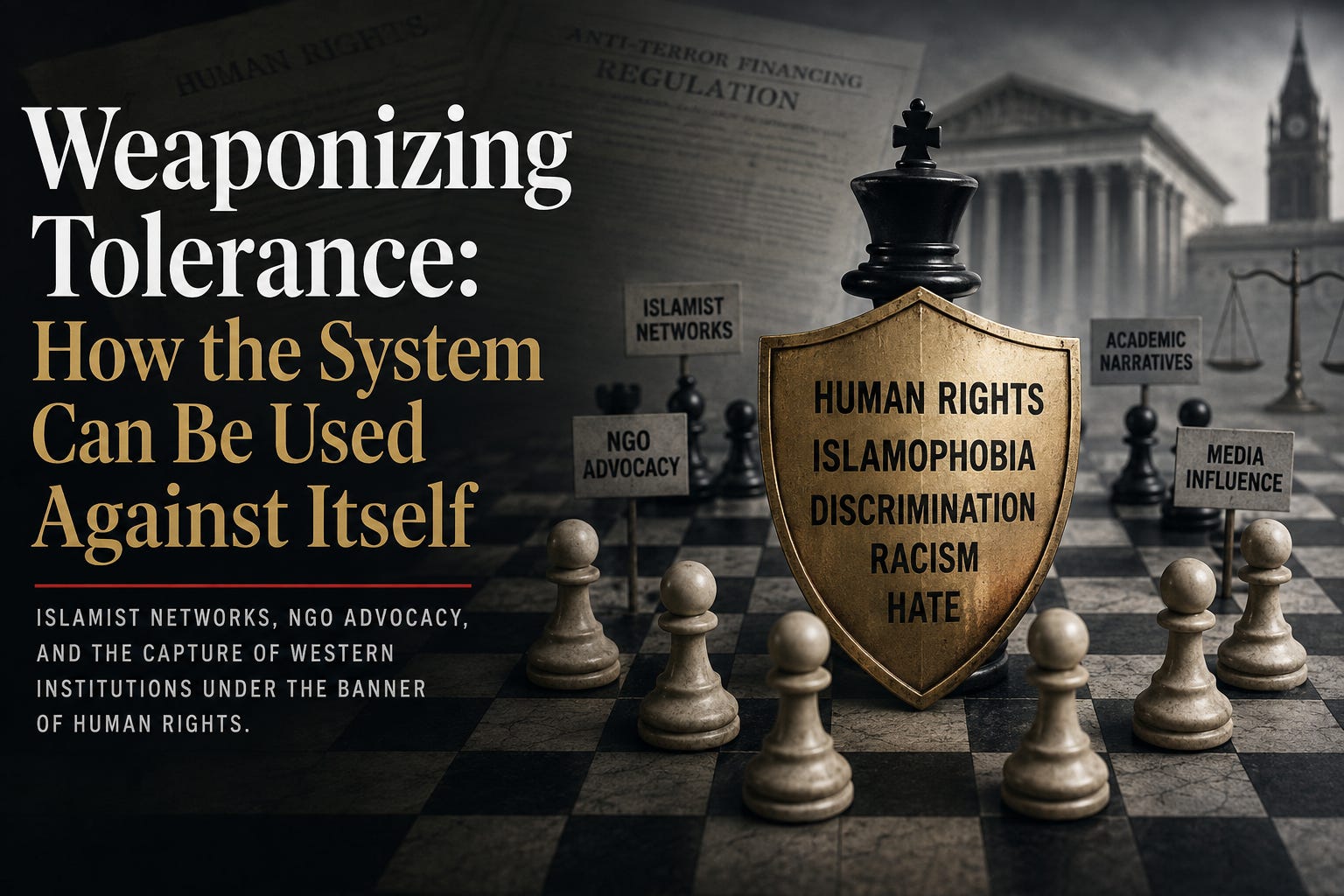
There is a story beneath the latest headline about Muslim charities, banking restrictions and Canada's anti-terrorism financing laws, and it is far more consequential than a dispute over charitable regulation. It is a story about how liberal democracies defend themselves, how advocacy becomes policy, and what happens when the very protections created to defend minorities from discrimination are invoked to make legitimate scrutiny increasingly difficult.
That distinction matters because there is a serious issue at the centre of this debate. Muslim charities should not be investigated because they are Muslim. They should not lose banking services because of their religion. They should not be presumed guilty because they operate in Muslim-majority countries. If the Canada Revenue Agency, a bank or any government institution discriminates against an organization because of the identity of the people running it, Canadians should demand accountability. That is not merely a concession to this discussion. It is one of the principles upon which a liberal democracy depends.
But another principle matters just as much. Membership in a minority community cannot provide immunity from legitimate scrutiny. An organization does not become less accountable to Canadian law because investigating it may provoke accusations of prejudice. A bank does not cease having obligations to identify suspicious financial activity because the client involved is Muslim. The CRA does not cease having an obligation to investigate legitimate concerns because the charity involved serves a minority community. And Canada does not cease having an obligation to prevent terrorist financing because doing so has become politically uncomfortable.
That is the real issue raised by the latest study authored by University of Toronto professor Anver Emon. The report, Humanitarianism and the Exclusion of Muslim Charities from the Financial Sector, argues that Canada's anti-money-laundering, anti-terrorist-financing and sanctions architecture has created serious obstacles for Muslim humanitarian charities. The argument deserves to be examined. Banks can overreact to risk. Governments can design rules with unintended consequences. Legitimate humanitarian organizations can find themselves trapped between the requirements of Canadian regulators and the realities of operating in some of the most dangerous places on Earth.
But the report did not materialize in an intellectual vacuum. That is where the story becomes more interesting, and where much of the media coverage becomes inadequate.
Emon has been engaged in this policy debate for years. In 2021, he co-authored Under Layered Suspicion: A Review of CRA Audits of Muslim-led Charities with Nadia Hasan, then a senior figure with the National Council of Canadian Muslims. That report argued that Canada's post-9/11 national-security architecture created structural vulnerabilities to bias in the treatment of Muslim charities. Emon subsequently provided expert evidence for the Muslim Association of Canada in its legal battle against the Canada Revenue Agency. He later testified before Parliament about systemic Islamophobia and discussed Canada's counter-terrorism architecture, including the terrorist-entities list, in the context of what he described as the post-9/11 "moral panic."
Then the argument moved closer to government.
Emon served on the federal government's Advisory Committee on the Charitable Sector from 2022 to 2024. According to the government's own records, he led work examining Canada's National Inherent Risk Assessment and its implications for charities. His academic research was no longer simply commenting on government policy from outside the building. The ideas he had been developing were now part of the environment in which government policy itself was being examined.
And now comes another study arguing that Canada's anti-money-laundering, anti-terrorist-financing and sanctions regime is harming Muslim humanitarian organizations.
None of this proves that Emon's research is wrong. It would be intellectually dishonest to pretend otherwise. An academic can hold strong views and still produce good research. An expert can provide evidence in litigation and still make legitimate arguments. An advocacy organization can identify genuine injustice. The point is not guilt by association. The point is intellectual transparency.
Canadians should understand how an idea travels.
It can begin as an argument within an advocacy community. Research gives the argument academic authority. Advocacy organizations amplify the research. Litigation places pressure on government institutions. Media coverage gives the argument public legitimacy. Parliamentary testimony moves it into the political bloodstream. Government advisory bodies translate ideas into recommendations. Eventually, what began as an argument about the system can become part of the process by which the system is redesigned.
There is nothing inherently improper about that. It is, in many ways, democracy functioning exactly as designed. Environmentalists do it. Corporations do it. Labour organizations do it. Jewish organizations do it. Civil-liberties organizations do it. Industries spend enormous amounts of money attempting to do it.
The danger comes when the ecosystem disappears from view and each stage is presented as independent validation of the last. Advocacy becomes research. Research becomes evidence. Evidence becomes media consensus. Consensus becomes policy. The public sees five different institutions apparently arriving at the same conclusion without necessarily being shown the intellectual and organizational connections between them.
That is why the background matters.
It also raises a more uncomfortable question about the West itself.
Liberal democracy possesses an unusual characteristic: it institutionalizes suspicion of its own power. We allow citizens to sue the government. We protect dissenters. We protect religious minorities. We permit academics to attack state policy. We empower journalists to investigate intelligence agencies. We create human-rights commissions and courts specifically capable of telling governments that they have crossed a line. We deliberately make state power difficult to exercise because history has taught us what happens when governments become too powerful and minorities too vulnerable.
These are not weaknesses. They are among the West's greatest achievements.
But every strength creates a vulnerability when people learn how the system works.
The language of human rights carries enormous moral authority in Western societies. So do accusations of racism, discrimination and Islamophobia. Often that language is necessary because the underlying discrimination is real. But moral language can also have a secondary effect: it can move the burden of scrutiny from the organization being examined to the institution doing the examining.
A regulator investigates an organization and suddenly the regulator is defending itself against allegations of systemic discrimination. A bank identifies a risk and the discussion shifts from the transaction to whether the bank is engaging in discriminatory "de-risking." A government examines extremist financing and the question becomes whether its national-security architecture is Islamophobic. A journalist investigates an organization and finds herself answering accusations that the investigation itself stigmatizes Muslims.
Notice what can disappear in that transformation.
The evidence.
That is the vulnerability we should be discussing. The most sophisticated way to weaken a liberal institution is not necessarily to confront it directly. Sometimes it is to force the institution to doubt the legitimacy of exercising its own authority.
This does not require a grand conspiracy. In fact, thinking about it as a conspiracy misses the more important point. Institutions respond to incentives. Politicians fear controversy. Corporations fear reputational damage. Universities fear accusations of discrimination. Government departments fear litigation. Journalists fear being accused of prejudice. Over time, those incentives can produce institutional hesitation without anyone issuing an instruction or coordinating a campaign.
And hesitation can become policy.
There is a phrase for the chilling effect experienced by communities that believe they are being unfairly scrutinized. We should take that chilling effect seriously. But there is another chilling effect we rarely discuss: what happens when the people responsible for scrutinizing legitimate threats become afraid to do their jobs.
What happens when a CRA investigator asks not only, "Does the evidence justify further examination?" but also, "What will happen to me if this becomes an Islamophobia controversy?" What happens when a bank's compliance department must calculate reputational risk alongside terrorist-financing risk? What happens when politicians become so terrified of conflating Islamism with Islam that they eventually become reluctant to discuss Islamism at all?
That is not tolerance. It is institutional paralysis.
And it is precisely why language matters.
Muslims are people. Islam is a religion. Islamism is a political project. Terrorist organizations are organizations. Financial networks are financial networks. These categories overlap in some circumstances and have absolutely nothing to do with one another in others. A functioning democracy must be capable of distinguishing between them.
Protecting Muslims from hatred does not require protecting Islamism from criticism. Protecting religious freedom does not require protecting political organizations from investigation. Fighting anti-Muslim discrimination does not require abandoning terrorist-financing safeguards. And scrutinizing the conduct of a Muslim organization is not the same thing as scrutinizing Muslims.
We understand this instinctively in other contexts. If the CRA investigated a Jewish charity based solely on the fact that it was Jewish, I would be among the first people demanding answers. But if evidence emerged suggesting that a Jewish organization had violated Canadian law, I would never argue that investigating it was inherently antisemitic. Antisemitism is real. It is not an immunity card.
The standard has to be universal.
Investigate conduct, not identity. Follow evidence, not ethnicity. Protect civil rights without creating civil immunity.
This becomes particularly important in terrorist financing because the underlying problem is genuinely difficult. Terrorist organizations do not finance themselves through bank accounts conveniently labelled "terrorism." Money moves through businesses, individuals, informal financial systems, front organizations and, in some cases internationally, charitable or humanitarian structures. Legitimate humanitarian organizations can also operate in territories where designated terrorist organizations exercise political, military or economic control. The same environment can therefore contain desperate civilians, legitimate aid workers and genuine security risks.
That complexity is exactly why enhanced scrutiny exists.
The question should never be whether Muslim charities deserve suspicion. They do not. The question should be how Canada allows legitimate humanitarian organizations to operate while ensuring that Canadian money, resources and infrastructure do not benefit terrorist organizations.
That is a difficult question. Difficult questions require better safeguards, better intelligence, better regulation and better oversight. They do not require pretending the risk disappears because discussing it is uncomfortable.
And this is where the current debate has consequences far beyond one professor or one study.
If Canada's national-security architecture is discriminatory, fix it. If CRA officials relied on flawed evidence, expose it. If banks are closing accounts without adequate justification, force them to explain themselves. If innocent organizations are being punished because they are Muslim, defend them.
But the burden of proof must work both ways.
The word "Islamophobia" cannot become a password that shuts down inquiry. "Systemic discrimination" cannot be an answer to evidence that has not yet been examined. Human rights cannot become a rhetorical force field around organizations whose conduct raises legitimate questions.
Otherwise we create a dangerous asymmetry: the state must endlessly prove the purity of its motives while the substance of what it was investigating becomes secondary.
That is not accountability.
It is inversion.
This is also why journalism matters so much. When a newspaper reports on research advocating changes to Canada's national-security architecture, readers deserve more than the study's conclusions and a quotation from its author. They deserve context. What has the researcher previously argued? Which organizations has the researcher worked with? Has the researcher provided expert evidence in litigation involving the institutions now being criticized? Has the researcher advised government on the policies being challenged? Are the recommendations new, or are they another stage in a longer campaign for institutional change?
Those questions do not discredit research.
They are how serious people evaluate it.
The same scrutiny should apply to research I agree with. If a study defending Israel were funded by a pro-Israel organization, tell me. If an expert criticizing antisemitism were simultaneously advising a Jewish advocacy organization, disclose it. The answer to selective transparency is not less transparency. It is more of it.
And that brings us to the larger lesson.
The West's openness is powerful precisely because it allows its institutions to be challenged. But openness without confidence can become vulnerability. A society that no longer distinguishes between prejudice and scrutiny will eventually become frightened of scrutinizing anything involving a minority community. A government that treats every accusation against its institutions as proof of institutional guilt will gradually surrender its ability to govern. A national-security apparatus that becomes more concerned with appearing virtuous than discovering what is true will eventually fail at both.
We do not protect liberal democracy by abandoning liberalism. Nor do we protect it by becoming intolerant.
We protect it by refusing false choices.
Canada can protect Muslim Canadians from hatred and investigate Islamist extremism. Canada can defend religious freedom and investigate terrorist financing. Canada can reform discriminatory practices and preserve effective national-security safeguards. Canada can listen to advocacy organizations without handing them a veto over the institutions they are seeking to change.
The principle is almost embarrassingly simple: no one should be investigated because of who they are, and no one should escape investigation because of who they are.
That should be the outcome of this debate.
And that is my call to action.
Read Emon's study. Don't burn it. Don't ban it. Don't dismiss it because you dislike its conclusions. Read it critically. Then read what came before it. Read Under Layered Suspicion. Read his parliamentary testimony. Read the federal advisory committee reports. Examine his expert evidence in the MAC litigation. Examine the government's response. Examine the arguments on the other side.
Then start asking our journalists and politicians a question they should be answering every time research is used to justify public-policy change:
Who is trying to change the system, what exactly do they want changed, and what happens if they succeed?
Because liberal democracy contains a paradox we should never forget.
Its enemies do not always need to destroy its institutions. They can benefit when institutions lose confidence in their own legitimate functions. They can benefit when scrutiny is confused with prejudice, when enforcement is confused with persecution, and when fear of appearing intolerant becomes stronger than the willingness to investigate uncomfortable facts.
The answer is not suspicion of Muslims. It is vigilance about institutions, ideologies, organizations and evidence, regardless of the identities involved.
We built a society in which minorities could challenge power because that is what free societies do.
We should be proud of that.
But we should also be wise enough to understand that every system of protection can be exploited, every moral language can be manipulated, and every institution can be pressured into forgetting why it exists.
The test of a liberal democracy is not simply whether it protects people from the power of the state. It is whether it can do so without becoming afraid to protect itself.
It’s a mass campaign to shift the conformists towards evil. All it takes are bullies with microphones and enough people buying into the groupthink. Conformists are desperate to be liked by the group. Heaven forbid the group call them mean. Conformists have been participants in some of the worst atrocities in history.